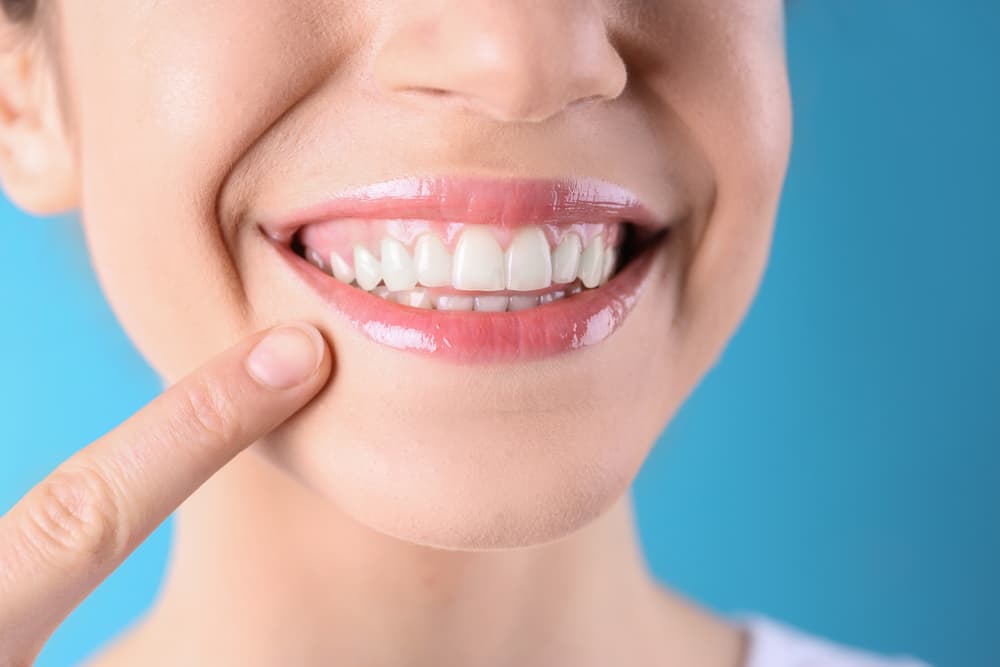
Teeth whitening uses a peroxide-based bleaching agent to break down organic stain molecules within tooth enamel and dentine, making the teeth appear lighter. It is safe when carried out by a licensed clinician using appropriate concentrations. It is also one of the few dental treatments that is entirely reversible — no tooth structure is removed, no permanent change is made to the tooth. If you decide later that you want a different approach, the whitening simply fades over time.
Whitening options compared
Two main approaches are available: in-office (professional, carried out at the clinic) and at-home (custom trays made by the clinic, worn at home over 2–3 weeks). Each has different characteristics.
| Option | How it works | Time | From |
|---|---|---|---|
| In-office / light-activated | High-concentration gel + activating light; carried out in the clinic | 60–90 mins, 1 visit | €180 |
| Laser whitening | Specialised gel activated by laser light; faster activation | 45–75 mins, 1 visit | €250 |
| Take-home trays | Custom-fitted trays with lower-concentration gel; worn daily at home | 2–3 weeks at home | €120 |
| Combined (office + home) | In-office session to kick-start, trays to maintain and top up | 1 visit + 1–2 wks at home | €280 |
Prices above are indicative and per patient. The best approach depends on your available time in Istanbul, your starting shade and any existing restorations. Your dentist will advise.
Laser teeth whitening in Istanbul
Laser whitening is a common search term, and it is worth explaining what it means in practice. In most clinics, the “laser” is an energy source — LED, plasma arc or a true laser — used to accelerate the activation of a peroxide gel applied to the teeth beforehand. The light itself does not whiten; it speeds up the chemical reaction of the bleaching agent.
In a session, the gum tissue is first protected with a barrier or liquid dam. The whitening gel is applied to the tooth surfaces and the light is positioned over the teeth for a series of cycles (typically 3–4 rounds of 10–15 minutes). The gel is removed between cycles and the shade is checked. Most patients see a noticeable change within the single appointment.
True laser whitening — using a calibrated dental laser to activate a specifically formulated gel — is also available at some Istanbul clinics. The protocol is similar but the activation is more targeted. Results are comparable to other light-activated systems for most cases.
Both are suitable for patients seeking a same-visit result during their time in Istanbul. If you are combining whitening with other treatments (veneers, crowns, smile makeover), the sequence matters — see the smile makeover page for how this is planned.
Honest expectations — what whitening can and cannot do
This section matters. The gap between what whitening marketing promises and what it actually delivers is real, and patients who book expecting a transformation sometimes feel disappointed. Here is what whitening genuinely offers and where its limits lie.
- Whitening only works on natural tooth enamel and dentine. Porcelain crowns, ceramic veneers, composite fillings and bonding are not affected. If you have visible restorations on front teeth and whiten around them, you may end up with a visible shade mismatch.
- Results vary significantly between patients. Yellow-toned staining from tea, coffee and tobacco typically responds well. Grey or brown tones — from tetracycline use, fluorosis or intrinsic discolouration — respond less predictably. Some intrinsic staining is barely affected by whitening alone.
- The result is not permanent. Teeth re-stain naturally over time, faster if you drink coffee, tea or red wine or smoke. Most patients need a top-up every 12–24 months. There is no whitening treatment that prevents staining permanently.
- It will not give you the same result as veneers. If you have intrinsic grey staining, visible chips, uneven shapes or old discoloured restorations, veneers or crowns are likely the better solution. Whitening is the right choice for naturally good teeth with surface staining.
Before whitening is recommended, your dentist will check for active decay, gum disease and the shade and condition of any existing restorations. If a different treatment would serve you better, you will be told plainly.
What teeth whitening costs in Turkey
Professional whitening in Istanbul is significantly less expensive than in the UK — though whitening is also one of the lower-cost dental procedures overall, so the absolute saving is modest compared to implants or veneers. It is, however, one of the easiest add-ons to combine with a larger treatment trip.
| Treatment | Istanbul (indicative) | UK private (indicative) |
|---|---|---|
| Take-home trays | from €120 | £250–£400 |
| In-office / light-activated | from €180 | £350–£600 |
| Laser whitening | from €250 | £400–£750 |
| Combined (office + trays) | from €280 | £500–£800 |
UK prices are indicative market ranges and vary by practice. Whitening as a standalone trip to Istanbul is rarely cost-effective once flights and accommodation are added — it makes most sense when combined with other treatment. See a full cost comparison →