A smile makeover is not a fixed product — it is a planning approach. The term describes a coordinated sequence of treatments, designed together so the final result is greater than the sum of its parts. Whether it involves 4 veneers and whitening, or 12 veneers, a gum lift and crown work on damaged teeth, the distinguishing feature is that every component is designed as part of a whole before any irreversible preparation begins.
Digital Smile Design
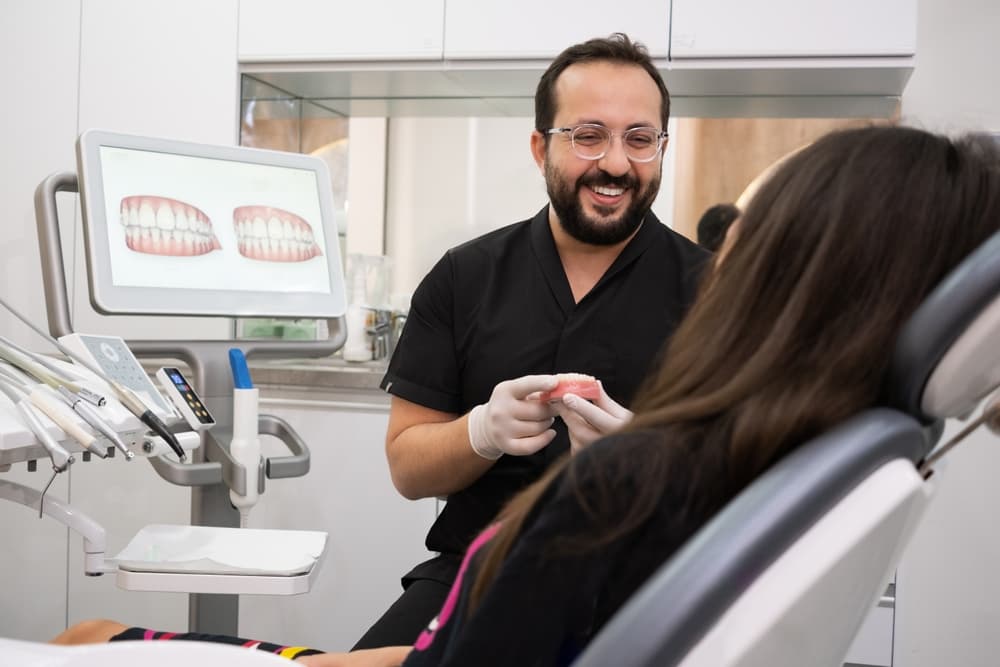
Digital Smile Design (DSD) is a clinical planning protocol developed by dental aesthetics specialists as a way to bridge the gap between what a patient imagines and what dentistry can deliver. It works by mapping your face, smile and teeth against a set of aesthetic reference points — and designing your result digitally before touching a single tooth.
The process in Istanbul typically involves:
Photography and video capture
High-resolution photographs and short video clips of your face at rest and smiling are taken from multiple angles. These are the raw material for the digital design — proportions, facial symmetry, lip line and gum exposure are all captured.
Digital design
The design software maps your facial proportions against established aesthetic references — the golden ratio, midline symmetry, tooth shape libraries. The dentist adjusts the proposed tooth shapes, lengths and shades digitally until the design makes visual sense for your specific face.
Design preview
You review the proposed result on screen — overlaid on photographs of your own face. This is the moment to ask questions, request changes and understand what you are committing to. Nothing irreversible has happened yet.
Mock-up (wax-up)
For larger makeovers, a physical mock-up of the proposed restorations is placed temporarily on your teeth so you can feel the shape and see the result in your own mouth, not just on a screen. This is an important step that some clinics skip — it should not be skipped for significant treatment.
Preparation and temporaries
Teeth are prepared (shaped) under local anaesthetic exactly as the design specifies — no more, no less. Temporary restorations matching the approved design are placed immediately.
Lab fabrication and final fit
The final restorations — veneers, crowns, or both — are crafted in the dental laboratory to the design specification. They are checked against the design at fitting, adjusted if needed, and cemented.
The value of DSD is not the software itself — it is the discipline of designing first and preparing second. It prevents the common cosmetic dentistry failure mode where individual treatments are carried out in sequence without a coherent overall plan, resulting in a result that looks treated rather than natural.
What a smile makeover typically includes
No two smile makeovers are identical — the right combination depends entirely on your starting point and goals. Below are the treatments most commonly incorporated, with a note on when each is appropriate.
- Porcelain or e.max veneers — thin shells bonded to the front surface of structurally healthy teeth to change shape, shade or minor alignment. See veneers in Turkey →
- Dental crowns — full caps for teeth that are cracked, heavily decayed or root-canal-treated and need structural protection as well as aesthetics.
- Professional whitening — typically performed before restorations are made so the final shade can be matched to your newly lightened natural teeth. See teeth whitening in Turkey →
- Gum contouring — reshaping an uneven or excessively visible gum line to create a more balanced frame for the teeth. Carries a short healing period.
- Composite bonding — a more conservative, reversible option for chipped or slightly misshapen teeth where no significant shade change is needed.
- Orthodontic pre-treatment — if teeth are significantly crowded or rotated, a course of aligners before the cosmetic work produces a better underlying canvas and typically reduces the number of units that need to be veneered or crowned.
A well-planned makeover uses the least invasive treatment for each tooth. A sound tooth that only needs whitening should not be veneered; a tooth that needs a crown should not have a veneer placed over a structural problem. The design phase exists to make these distinctions clearly.
Smile makeover vs Hollywood Smile
The term “Hollywood Smile” describes a specific aesthetic outcome: a full set of uniform, very white veneers or crowns across all visible upper (and often lower) teeth, typically 16–20 units. It is named after a particular look and tends to be maximalist — all teeth treated to a single consistent standard.
A smile makeover is a broader term that does not imply any particular number of units or a specific aesthetic direction. It could be 4 veneers and whitening to address one part of the smile; it could be a full-arch transformation. The unifying principle is coordinated planning — not coverage.
Which is right depends on your goals and your starting point. If your teeth are structurally sound but you want a dramatic, uniform change across your whole smile, a Hollywood Smile may be appropriate. If you have a mix of concerns — some teeth that need structural work, others that are fine, a gum line issue and a colour problem — a makeover planned around what each tooth actually needs is likely to serve you better.
Read more about the Hollywood Smile in Turkey →
What a smile makeover costs in Turkey
Because a smile makeover combines multiple treatments, the cost varies more than almost any other dental procedure. The table below gives an indicative sense of the range by type of makeover — your itemised plan will be specific to your case.
| Makeover type | Istanbul (indicative) | UK private (indicative) |
|---|---|---|
| Mini makeover (4–6 veneers + whitening) | from €2,900 | £5,000–£9,000 |
| Standard makeover (8–12 veneers + whitening + gum) | from €4,500 | £8,000–£15,000 |
| Full makeover (16–20 units + gum + crown work) | from €7,500 | £15,000–£25,000+ |
UK figures are indicative ranges from cosmetic dental practices. Factor in flights and accommodation. All Istanbul prices above include the Digital Smile Design process and a written 5-year guarantee on materials and workmanship. See a full cost comparison →