All-on-4 is a surgical technique that replaces an entire arch of teeth — upper, lower, or both — using just four dental implants. Two implants are placed vertically at the front of the jaw; two more are angled at the back to make the most of available bone. A fixed bridge is then attached, giving you a complete, non-removable set of teeth. All-on-6 follows the same principle with six implants for greater load distribution. Both are permanent alternatives to full dentures for people who are missing most or all of their teeth in a jaw, or whose remaining teeth cannot be saved.
Is All-on-4 right for you?
All-on-4 and All-on-6 are specifically designed for patients who need a full-arch solution. The technique is particularly well-suited to:
- People with a failing arch — teeth that are heavily decayed, broken down, or require multiple extractions that would leave an essentially edentulous jaw
- Long-term denture wearers who find their dentures unstable, uncomfortable or restricting in what they can eat, and want a fixed alternative
- Patients who have experienced bone loss in the jaw but still have sufficient volume for angled implant placement — one of All-on-4's core advantages over conventional implants is that the angled technique often eliminates the need for bone grafting
- People in good general health who can commit to the two-trip process and the post-operative maintenance that long-term success requires
Not everyone asking about All-on-4 is a candidate straight away. If you still have several healthy, restorable teeth in an arch, preserving them is usually the better clinical decision — sometimes a combination of individual implants, crowns and bridges is a more conservative and appropriate plan. Patients with very severe bone loss may require a sinus lift, bone graft, or zygomatic (cheekbone-anchored) implants before or instead of standard All-on-4. Uncontrolled diabetes, active heavy smoking, and certain medical conditions affecting bone healing require careful discussion before proceeding.
The definitive answer to whether All-on-4 is right for you comes from a 3D CBCT scan — a low-dose cone beam CT that maps your bone volume, density and anatomy in three dimensions. No reputable specialist will confirm candidacy without one.
If your scan reveals that a bone graft or alternative approach is needed, we will tell you clearly — along with what that means for cost and timeline — before any treatment is agreed. We would rather give you a frank assessment than a headline figure that changes later.
All-on-4 vs All-on-6 vs All-on-8
The number in the name refers to how many implants support the full-arch bridge. More implants means more load-sharing contact points — but more is not automatically better. The right number for you is determined by your bone anatomy and bite forces, not by budget alone.
| Option | Best for | From |
|---|---|---|
| All-on-4 | Most full-arch cases; moderate bone loss; standard bite | €3,400 |
| All-on-6 | Stronger bite; denser bone allowing extra implants; greater stability margin | €4,200 |
| All-on-8 | Premium full-mouth stability; maximum load distribution; high-density bone | €5,200 |
All-on-4 is the most widely used technique and works well for the majority of patients. The angling of the posterior implants distributes force effectively across a 10–14 tooth bridge without requiring bone grafting in most moderately resorbed jaws. It is a proven, well-researched approach with strong long-term data.
All-on-6 adds two more implants — typically placed further back in the arch — for a wider base of support. This becomes clinically meaningful when a patient has above-average bite force (larger build, history of bruxism), when bone quality is particularly dense and accommodates more implants naturally, or when the specialist assesses that the additional contact points will meaningfully improve long-term bridge stability. It is not categorically superior to All-on-4; it is simply the right choice in certain cases.
All-on-8 represents the maximum implant count for a single arch and is used in premium full-mouth restorations where the patient has excellent bone volume and wants the highest achievable load-distribution. It is less common and generally reserved for specific clinical indications — your specialist will recommend it only where the anatomy supports it.
All-on-4 vs traditional dentures
For patients weighing up their options, the comparison with conventional full dentures is worth examining honestly — including where dentures remain a sensible, legitimate choice.
| Factor | All-on-4 | Full denture |
|---|---|---|
| Fixation | Permanently fixed — does not come out | Removable; relies on suction and/or adhesive |
| Chewing ability | ~80–90% of natural bite force | ~20–25% of natural bite force |
| Bone preservation | Implants stimulate bone; prevents resorption | No stimulation; bone continues to resorb over time |
| Maintenance | Daily brushing; professional clean 1–2× per year | Daily removal and cleaning; periodic relining |
| Cost (initial) | From €3,400 per arch | Much lower — from a few hundred euros |
| Long-term cost | Lower — implants last decades; bridge replaceable | Ongoing relining, replacement as jaw shape changes |
All-on-4 offers significant practical advantages for most patients who are medically suitable: the stability difference is substantial, and the bone-preservation benefit is clinically important over a 10–20 year horizon. However, dentures are not wrong for everyone. For older patients with significant systemic health conditions that increase surgical risk, patients for whom the cost of implants is genuinely prohibitive, or those who simply prefer a non-surgical option, a well-made full denture is still a legitimate treatment. The role of our specialist is to present both options honestly and let you decide with accurate information.
What happens, step by step
All-on-4 treatment is designed to be efficient — implant placement and a temporary fixed bridge often happen within 24–48 hours of arrival. But the process is two-stage, and we will always be direct about this: the final permanent bridge requires a return visit after the healing period.
Assessment & CBCT scan
A comprehensive clinical examination, full-arch photographs and a 3D cone beam CT scan. The scan maps your bone volume and density, identifies the optimal implant positions and angles, and confirms whether any extractions or preparatory work are needed. No implants are placed without this step.
Implant placement & temporary bridge
Under local anaesthetic (sedation is available if preferred), remaining teeth are extracted as needed, implants are placed, and a fixed temporary acrylic bridge is attached — usually on the same day or within 24 hours. This is the "teeth in a day" stage: you leave with a complete, non-removable set of teeth you can eat soft food with immediately. The temporary bridge is carefully designed so it does not overload the healing implants.
Healing at home
Osseointegration — the process by which titanium fuses with living bone — takes 3–6 months depending on bone density and individual healing. During this period you follow a soft diet (no hard or crunchy food) and maintain meticulous oral hygiene around the implants. We stay in contact and help coordinate any aftercare needed near your home. Most patients experience this period without significant issues; you will still have your temporary bridge and can function normally.
Final permanent bridge
Once osseointegration is confirmed (usually by X-ray), you return to Istanbul for your definitive bridge — typically a zirconia or titanium-reinforced prosthesis that is stronger, more stain-resistant and more precisely fitted than the temporary. This visit is usually 2–3 days. The final bridge is checked for fit, bite and aesthetics before being permanently attached.
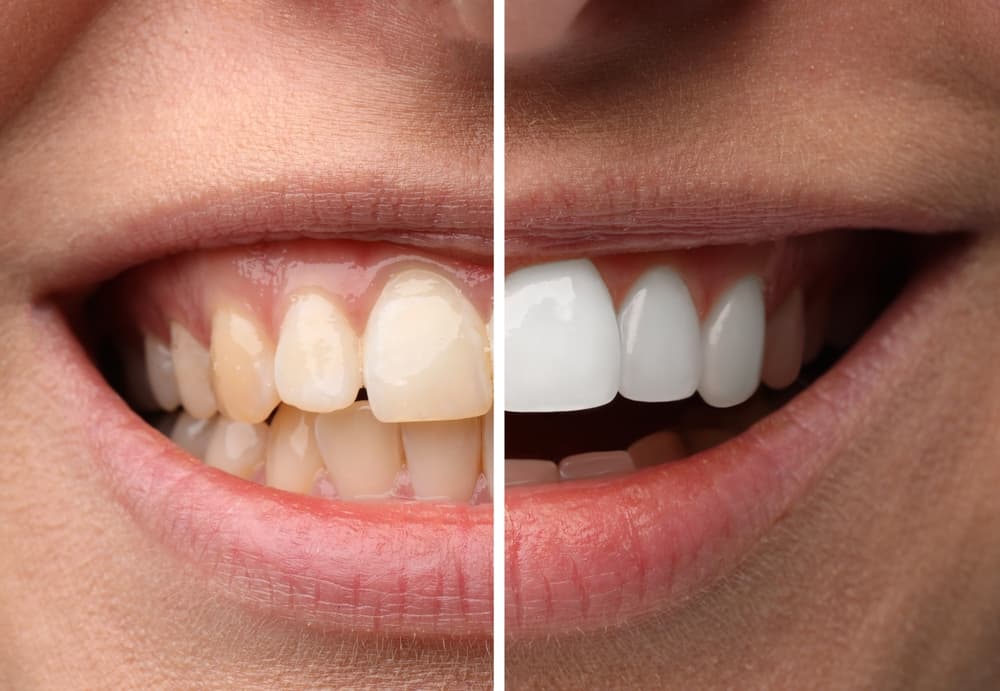
Real patient results
Real cases, shown with consent. Outcomes vary by individual.
The materials we use
The cost advantage of All-on-4 treatment in Turkey compared to the UK or Western Europe comes from lower clinic overheads and local labour costs — not from inferior materials or implant systems. Our partner clinic uses the same implant brands found in leading European practices, with material certifications that travel with your treatment records.
Implant systems: Straumann (Switzerland) and Nobel Biocare (Sweden/USA) are the two most extensively researched implant brands in the world, with 20+ years of published long-term outcome data. Both are used at our partner clinic. Your treatment plan will specify which system is being used and why.
Bridge materials: The temporary bridge fitted at placement is typically high-impact acrylic — lightweight and adjustable, designed for the healing phase. The final bridge is either a zirconia-based prosthesis (extremely strong, highly aesthetic, metal-free) or a titanium-frame bridge with acrylic or porcelain teeth, depending on your case and preference. Both are lab-fabricated to your specific measurements.